
.png)


How to Navigate HDB’s New Play Values Framework; Explained
Updated: Mar 2
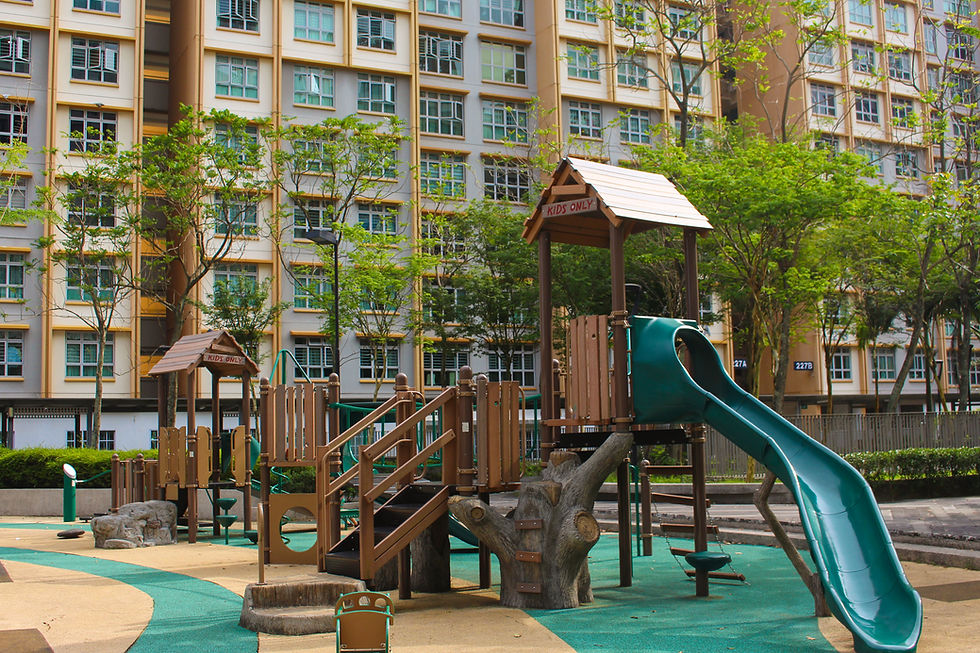
In recent years, Singapore’s approach to playgrounds has shifted significantly. Gone are the days when a playground was simply defined by slides, swings, and colourful climbing frames. Today, the focus is increasingly on what children experience when they play, not just what they play on.
This shift is embodied in the Housing & Development Board’s (HDB) Play Values Framework, a guide that helps designers and communities think more deeply about how play spaces support children’s development, movement, social interaction, and sensory exploration. Understanding this framework can help parents, caregivers, and local planners appreciate not only the looks of a playground, but its purpose and impact on children’s growth.
In this article, we unpack HDB’s new play values framework in clear, accessible terms and explain why it matters for families across Singapore.
Rethinking Play in Singapore: Beyond Slides and Swings HDB play values framework

Traditional playgrounds in Singapore were often judged by the number and size of their play equipment. The taller the slide, the longer the monkey bars, the better, right?
Not necessarily. What matters more today is whether a playground:
Encourages children to move in different ways
Stimulates all their senses
Supports social interaction and imaginative play
Is inclusive for children of varying abilities
HDB’s play values framework reflects this more holistic understanding of play. Rather than focusing solely on specific equipment, it asks: What experiences does a play space offer children?
What Are Play Values?

Play values are the qualities or opportunities a space provides that make play meaningful and beneficial for children. In other words, they are the hidden benefits of a playground. The things children learn and gain from their play experiences.
HDB’s framework identifies several key play values that good playgrounds should support. These go well beyond physical activity to include sensory, social, creative, and cognitive experiences.
Here are the main play values emphasized in the framework:
1. Physical Play: Moving, Climbing, Balancing, and Exploring

Physical play remains a fundamental part of childhood. It helps children develop strength, coordination, balance, and confidence.
Under the play values framework, designers are encouraged to think beyond standard elements like ladders and slides. They consider how the layout encourages varied movement, such as:
Stepping stones that challenge balance
Low climbing features for exploration
Multiple paths that support running and chasing games
Physical play in this framework is not about dominating one piece of equipment. It’s about engaging the whole body in a variety of ways.
2. Sensory Play: Engaging All the Senses

Sensory play refers to experiences that stimulate a child’s senses. The senses typically include touch, sound, sight, smell, and even proprioception (body awareness). Singapore’s tropical environment naturally lends itself to sensory play, whether through water, sand, natural textures, or plant life.
Examples of sensory experiences include:
Water jets that vary in pressure and rhythm
Textured surfaces underfoot
Natural materials like wood or stone
Movement features that create sound or visual feedback
Sensory play supports children’s curiosity and helps them process information about the world around them. It also appeals to children with different learning styles, including those who may struggle in traditional play settings.
3. Social Play: Cooperation, Conversation, and Shared Fun

Playgrounds are social spaces, and the play values framework emphasises the importance of features that encourage interaction.
Social play may occur when children:
Take turns on a feature
Create games together
Solve problems as a duo or group
Engage in guided play with caregivers
A bench placed near a group of play elements, or a slightly elevated zone where children can gather, can make a big difference in fostering social exchange.
4. Creative and Imaginative Play: Spaces That Encourage Storytelling and Role-Play

Movement and social interaction are valuable, but so too is the opportunity to imagine, invent, and make up stories. HDB’s framework highlights creative play as a core play value.
Creative play might involve:
Open spaces that allow children to invent their own games
Loose-parts play (objects children can use in many ways)
Elements that suggest different roles, such as but not limited to “cooking,” “exploring,” or “building”
Imaginative play encourages children to think flexibly, use language creatively, and engage in symbolic thinking. These skills are valuable far beyond the playground.
5. Risk and Challenge: Graduated Experiences That Build Confidence

While safety is always a priority, the play value framework recognises that managed risk is an important part of play. Children learn resilience, judgement, and confidence when they tackle challenges that are slightly above their ability level.
This could include:
Balance beams that are low to the ground
Uneven steps that vary in height
Slight inclines that encourage careful movement
The idea is not to create hazards, but to introduce opportunities for children to learn what they are capable of through practice and experience.
6. Inclusive Play: Welcoming Children of All Abilities

An important emphasis of the framework is inclusivity. Play spaces designed with inclusivity in mind ensure that children of different ages, physical abilities, and sensory needs can all participate.
Inclusive design might involve:
Ramped access to raised platforms
Ground-level play experiences that don’t require climbing
Sensory features that engage children at varying levels
Clear signage and safe surfacing throughout
When a playground supports inclusive play, it becomes a space where siblings, friends, and families can share experiences with no one left on the sidelines.
Why the Play Values Framework Matters to Families

For parents and caregivers, the shift toward play values means that playground quality is no longer measured by equipment alone. Instead, it is evaluated by the experiences it offers. The moments of discovery, interaction, challenge, and joy.
A playground designed with strong play values:
Encourages longer and more varied play
Supports development across multiple domains
Feels welcoming to children of different abilities
Offers sustained engagement over time
This aligns with broader goals in Singapore’s health and education landscape, where holistic child development is a priority.
Making Sense of Play Value in Everyday Playgrounds

You don’t need a technical scorecard to see play values in action. When you observe children at play, look for:
A child choosing their own way to engage
Groups inventing games together
Siblings of different ages playing side by side
Children returning to a feature with new ideas
These are signs of high play value, experiences that go beyond physical movement and tap into a child’s creativity, confidence, and social engagement.
Conclusion
HDB’s play values framework marks an important shift in how we think about play spaces in Singapore. It moves the conversation from what playgrounds look like to what children experience in them. By emphasising physical, sensory, social, creative, and inclusive play, the framework ensures that playgrounds become environments where all children can grow, explore, and connect.
Whether you are a parent, caregiver, planner, or community leader, understanding play values helps you appreciate not just the structure of a playground, but its impact on children’s development and everyday joy.
A great playground is not just a place to play; it is a place where children learn about themselves and the world around them.
Want to start on your next project? Looking to create a playground that balances design and play value? Retro-Max works with communities and planners to design play spaces that are both visually engaging and deeply rewarding. Contact us today


Comments